



Raphael’s Frescoes: Nature, Myth, and Mastery in Trastevere
The harmony of Raphael frescoes, his scandalous romances and artistic rivalry with Michelangelo in Villa Farnesina
24 December 2025
Rome Travel GuideWhen travelers dream of seeing Raphael’s masterpieces in Rome, they almost instinctively book a ticket to the Vatican Museums. But there is a secret that art historians and locals have known for centuries: you don't need to fight the crowds in the Sistine Chapel to experience the genius of the Italian Renaissance.
Tucked away in the charming neighborhood of Trastevere lies Villa Farnesina, arguably the most harmonious creation of the Roman Renaissance. It offers an intimate, crowd-free encounter with Raphael, Peruzzi, and Sebastiano del Piombo, all set within a magnificent riverside villa.
Here, Raphael moved away from the heavy theological themes of the Papacy to create works of profound sensuality and mythological storytelling. His frescoes in this riverside villa are not merely decorations; they are windows into a "Golden Age" of Roman art where humanism and beauty reigned supreme.
The Triumph of Galatea: The Pursuit of Ideal Beauty
In the Loggia of Galatea, visitors are immediately drawn to one of the most celebrated images in Western art. Raphael’s fresco Triumph of Galatea depicts the sea-nymph fleeing the clumsy advances of the Cyclops Polyphemus, yet the scene we see today is only a fragment of a grander vision. Historical evidence suggests that the walls were originally intended to be decorated with a full cycle of scenes from the nymph's life which were never completed. Consequently, the existing frescoes do not depict the primary narrative arc of her story, but rather a singular moment of apotheosis. In a brilliant use of the villa’s architecture, the giant Polyphemus is relegated to the adjacent panel, where he is forced to watch helplessly as Galatea glides away from him.
The composition itself is a masterclass in perfectly measured movement, defined by a dancing, swirling rhythm that radiates from Galatea as she twists elegantly around herself. Drawing on ancient models, Raphael recreated a mythical classicism that feels both timeless and otherworldly. He employed crystalline, precious tones that betray an in-depth knowledge of ancient Roman painting, long before the rediscovery of Pompeii. The striking "Pompeian" red of Galatea's dress serves as a vibrant focal point, standing out in sharp relief against the cool, marble-green surface of the sea.
While Raphael famously claimed the nymph was born from an abstract ideal of beauty, modern research offers a more personal historical insight. It has been proven that the facial features of the Nereid are those of Margherita Luti, Raphael’s great love and muse. Margherita is the same woman who posed for the Sistine Madonna (1514), La Velata (1516), and the iconic La Fornarina (1519). Interestingly, the Triumph of Galatea, dating from 1512, is the first painting in which this beloved muse appears in Raphael's work.
The story of their meeting is as romantic as the fresco itself. Many believe that Raphael and Margherita first met while he was working in Agostino Chigi’s villa. Margherita, the daughter of a local baker, frequently visited the site to deliver bread from her family's bakery in Trastevere. Their connection was so intense that Raphael reportedly spent more time with her than at his easel. To ensure the project’s completion, Chigi was eventually forced to invite Margherita to stay at the villa, allegedly because Raphael threatened to abandon the project entirely if his lover was not by his side. It was under these passionate circumstances that Raphael painted the face of Galatea, forever immortalizing Margherita Luti as the pinnacle of Renaissance beauty.
The Loggia of Cupid and Psyche: An Indoor Garden Shrouded in Myth
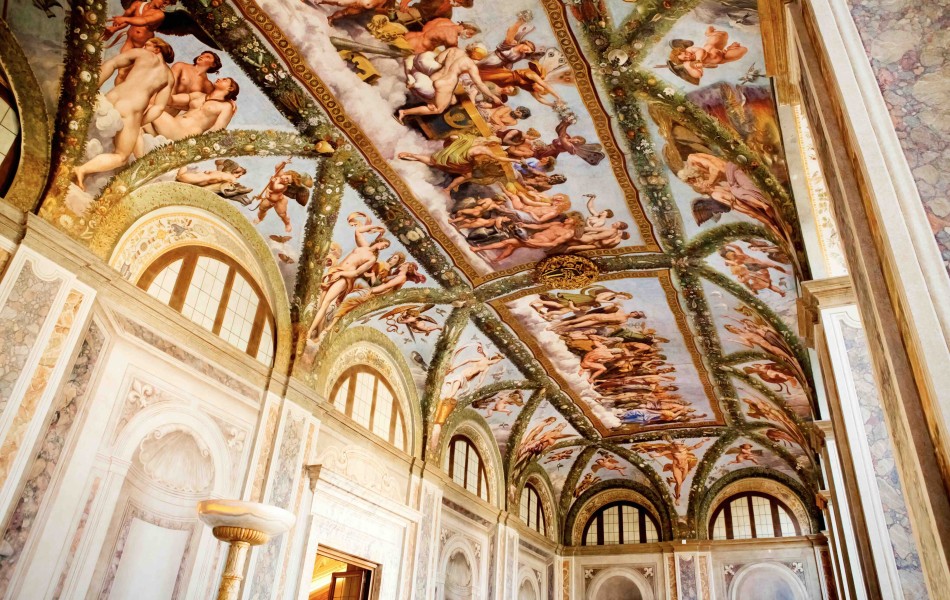
In 1517, Raphael returned to the villa to decorate the grand entrance loggia, creating a space where the boundaries between interior architecture and the surrounding landscape completely dissolve. Working with his most talented pupils, he conceived a decorative scheme that functions as a seamless extension of the villa's greenery. The scenes are set within an intricate framework of plant festoons, the meticulous work of his pupil Giovanni da Udine. These lush garlands simulate a massive garden pergola, dividing the vault into geometric compartments set against a brilliant sky-blue background. This constant presence of botanical intertwining enhances the sense of continuity between the loggia and the actual garden just beyond the arches.
Within this "garden room," Raphael unfolds the ancient tale of Cupid and Psyche, a narrative that carried deep personal significance for the villa's owner. Scholars have long linked the mythological protagonist, Psyche, with Francesca Ordeaschi, the lover of Agostino Chigi. Francesca’s life mirrored the trials of Psyche; she famously rose from the status of a humble courtesan to the rank of the banker’s legitimate wife, a social ascension that was scandalous for the time. The cycle, which follows the mortal Psyche’s struggle against the jealousy of Venus and her ultimate welcome into Olympus, culminates in two massive ceiling scenes: the Council of the Gods and the final, magnificent Wedding Banquet. These central panels were intended to mirror the real-life romance of Chigi and Francesca, celebrating a human love that, through perseverance, was elevated to the divine.
The botanical details surrounding these figures are a marvel of Renaissance science and naturalism. Around two hundred distinct botanical species can be recognized within the greenery. While many are domestic plants familiar to 16th-century Italians, the frescoes also include a significant number of "exotics" imported from the Americas. Having been discovered only a few years prior to the painting's execution, the inclusion of plants like maize and pumpkins served as a visual testament to Chigi’s global reach as a banker and the dawn of a new era of exploration. The resulting atmosphere, defined by soft, luminous figures and a joyful, pagan eroticism, stands in stark contrast to the somber religious art of the era, making the loggia a true sanctuary of Renaissance humanism.
The Mystery of the Charcoal Head of Michelangelo
Even in a space dominated by Raphael’s grace, a shadow of his great rival remains. High in one of the lunettes of the Sala di Galatea is a large, monochrome head sketched in charcoal. While modern scholars often attribute it to the architect Baldassare Peruzzi, a persistent and beloved legend tells a different story.
It is said that Michelangelo, curious about the work his rival was doing for the wealthy Chigi, snuck into the villa in disguise. Finding Raphael absent, he climbed the scaffolding and left this massive, powerful sketch as a silent critique of Raphael’s smaller-scale figures. When Raphael returned and saw the mastery of the charcoal lines, he allegedly recognized the hand of Michelangelo instantly. Rather than painting over it, he ordered the sketch to be preserved exactly as it was, a permanent tribute to the artistic tension that fueled the Roman Renaissance.
Our categories:
You may also be interested ...
Vatican Private Tour with Sistine Chapel & St. Peter's Basilica: Renaissance’s Wonders
Private tour
Discover with a skip the line Private Vatican Tour the Sistine Chapel, Vatican Museums and St Peter’s Basilica
starting from: € 275

Colosseum Guided Audio Tour with Roman Forum and Palatine Hill
Private tour
Discover Ancient Rome’s secrets and history with our immersive Colosseum guided audio tour, rich in image and content
starting from: € 51 € 42